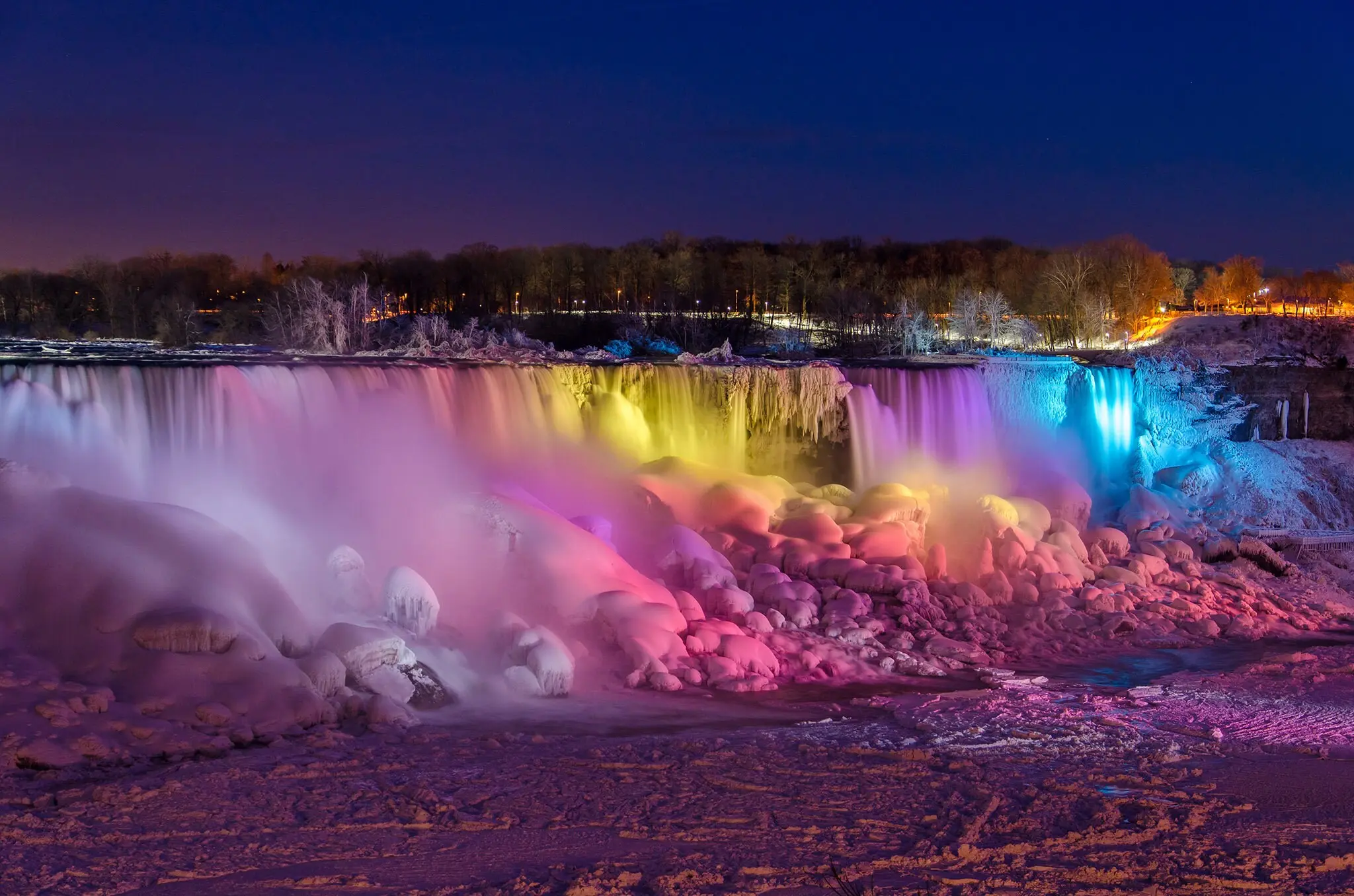
1. Niagara Falls, Ontario
Niagara Falls is not just a water cascade; it has become a world tourism icon. The number of visitors annually on the Canadian side is an average of 12 million people who come to watch 2.8 million litres of water falling over the Horseshoe Falls after every second of peak flow (Ref: survey report).
Queen Victoria Park
The most panoramic views are seen on one of the well-lit landscaped walks of Queen Victoria Park with flower gardens on one side and cascading waters on the other, illuminated in many colours of the rainbow at night.
Journey Behind the Falls
To dig a little further, the journey behind the Falls has tunnels and platforms that are just steps away from the thundering wall of water, an experience that is to be remembered.
Niagara SkyWheel
On blurred-cool mornings when the mist rains down, look around and above: the Niagara SkyWheel, a 175-foot Ferris wheel, is completely enclosed and offers a view of the American and Canadian sides.
Winter Festival of Lights
Come in the winter to see the twinkle of the Winter Festival of Lights, Canada’s largest light festival that has free displays on an eight kilometer route between mid-November and mid-January.
Pro Tip
To get a vision of the more natural end of the spectrum, either walk or bike the Niagara Gorge trails along the northern area outside the major observation area.
Don’t be left out regarding the U.S. side as well; carry your passport and you will see less developed yet appealing views.
2. Banff National Park and Moraine Lake, Alberta
Banff was the oldest national park in Canada and it was visited by more than 4 million people in the last two years. Travellers must visit the emerald lakes which are glacier-fed such as the Moraine Lake which is positioned in the Valley of the Ten Peaks at an elevation of 1,884 m. Majestically located on the west where only park shuttle or bicycles can travel since personal vehicles are banned since 2023, the lake at its peak melt presents a beautiful hue of blue that once adorned the face of the now-deceased Canada.
The Town of Banff
The town of Banff is an idyllic home base - there are rustic lodges here, indie galleries, and warm mountain hospitality.
Top Things to Do in Banff
Hike Tunnel Mountain at dawn for views of Bow River.
Visit Sulphur Mountain and take the Banff Gondola up.
Explore Bow River and enjoy the famous hot springs.
Join indigenous-led tours for a deeper connection with the land.
Take wildlife tours to experience Banff’s natural wonders.
3. Historic District of Old Qu qubec, Quebec City, Quebec
Old Quebec is like a step into 17th Century France with the fortified walls, the 2000-year old cobblestones and the gas lit glamour. This 135 hectare, the only viable walled city in North America, was classified as World Heritage by UNESCO in 1985 due to its exceptionally preserved colonial structure and plan. The Fairmont Le Chateau Frontenac towers over all of the views as it sits atop the banks of the St. Lawrence River, and is often referred to as the most photographed hotel in the world. It was constructed in 1893 by the Canadian Pacific Railway, with the shape of its silhouette of copper turrets creating a culture and visual stronghold in Québec City.
Historic Highlights
Walk along the 14th-century fortifications.
Explore Rue du Petit Champlain with its charming shops.
Visit Place Royale, where Samuel de Champlain originally settled the French colony.
Discover La Citadelle, a fortress still in use and a historic museum visited by around 200,000 people each year.
See the Cathedral Basilica of Notre-Dame de Québec, dating back to 1647 and home to the only Holy Door on the continent outside of Europe.
Events and Cultural Life
Bath is a vibrant city with cultural life which beats throughout the whole year. In July, the Festival d'été de Québec (Quebec Summer Festival) attracts up to 1.5 million spectators to free outdoor stages and concerts held under the city walls.
Leisure and Experiences
Go window-shopping in the charming streets.
Enjoy a maple latte and live jazz on the Dufferin Terrace.
Take in postcard-worthy views and architectural wonders around every corner.